
One of the most common questions homeowners ask at the start of a project is simple: How long will permits take?
It’s a fair question, especially when you are eager to begin construction. But the answer usually starts earlier than most people expect.
Permits do not begin with paperwork. They begin with design. Permits are legal documents submitted to a jurisdiction to demonstrate that a project complies with building codes. That means the design must already be fully developed before a permit application can even be submitted.
Ideas, inspiration boards, and rough sketches are valuable starting points. However, they are not enough for permit approval. Jurisdictions require a complete design that clearly demonstrates how a building will work and how it meets code requirements.
Understanding this distinction explains why the design process exists and why it plays such an important role in how smoothly a project moves from concept to construction.
Why Design Comes First
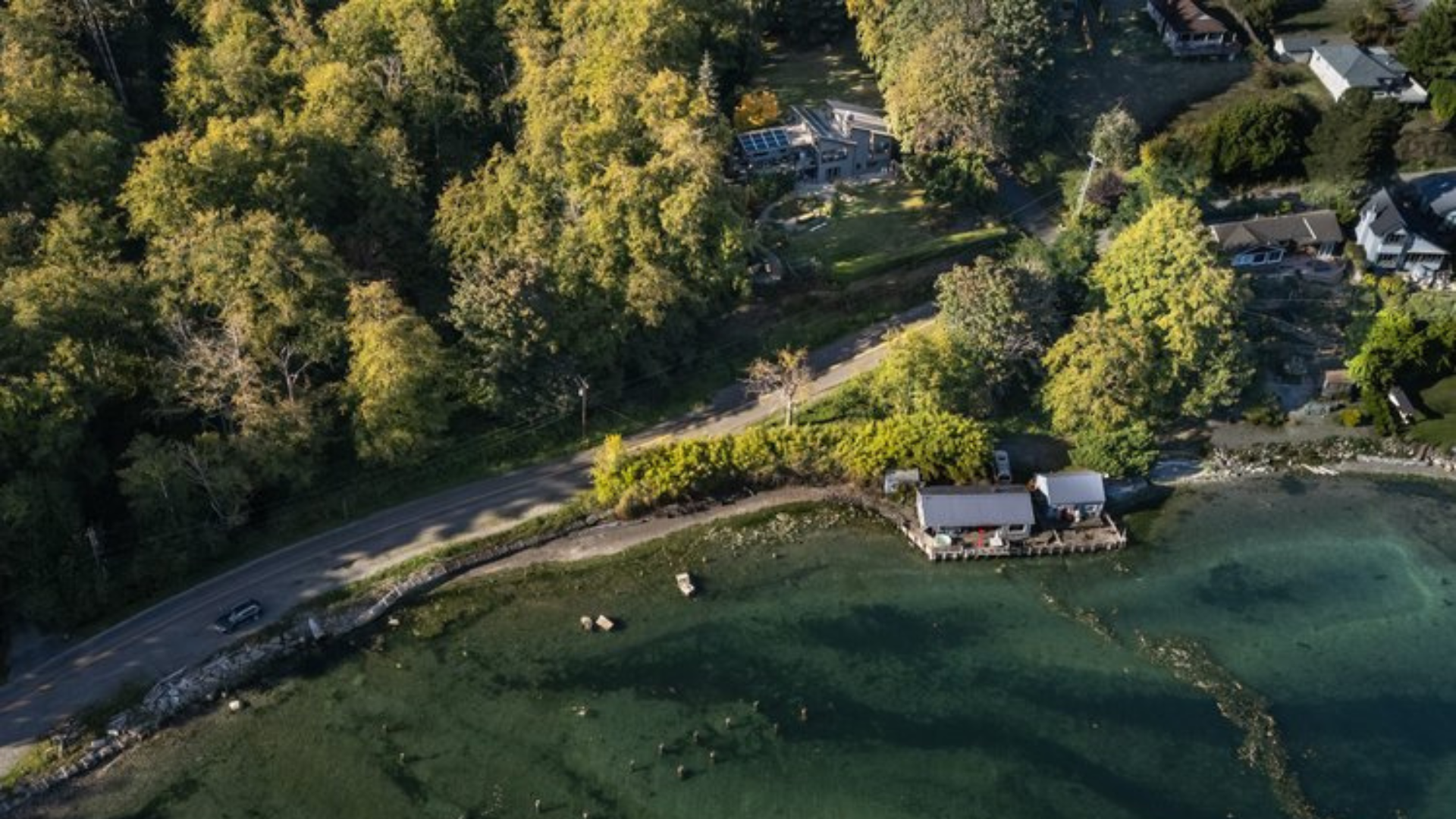
In this video, Rachel explains:
Why permits depend on complete design
The difference between permit drawings and construction drawings
The design phases that make permits possible
Why skipping design often creates delays
1. You Cannot Permit an Idea
Many homeowners begin a project believing they already have a design.
Often, what they actually have is a vision, which is a great place to start. But a vision is not the same as a design that demonstrates code compliance.
For a permit review, jurisdictions require drawings that clearly communicate:
Dimensions and spatial relationships
Structural intent
Mechanical and building systems
How the project complies with local building codes
Without this level of information, the jurisdiction cannot evaluate or approve the project.
2. Permit Drawings vs Construction Drawings
Another common point of confusion is the difference between permit documents and construction documents.
Both are built on the same foundation: a fully developed design.
Permit Documents
Permit drawings are submitted to the jurisdiction and demonstrate that the project meets building code requirements.
These drawings typically show:
Building layout and dimensions
Structural intent
Basic building systems
Code compliance information
Construction Documents
Construction documents are created for the builder and include additional information needed to construct the project.
These drawings typically include:
Detailed assemblies
Material specifications
Finish selections
Construction details
Even though these drawings serve different purposes, both require a thoroughly developed design.
3. The Design Process That Makes Permits Possible
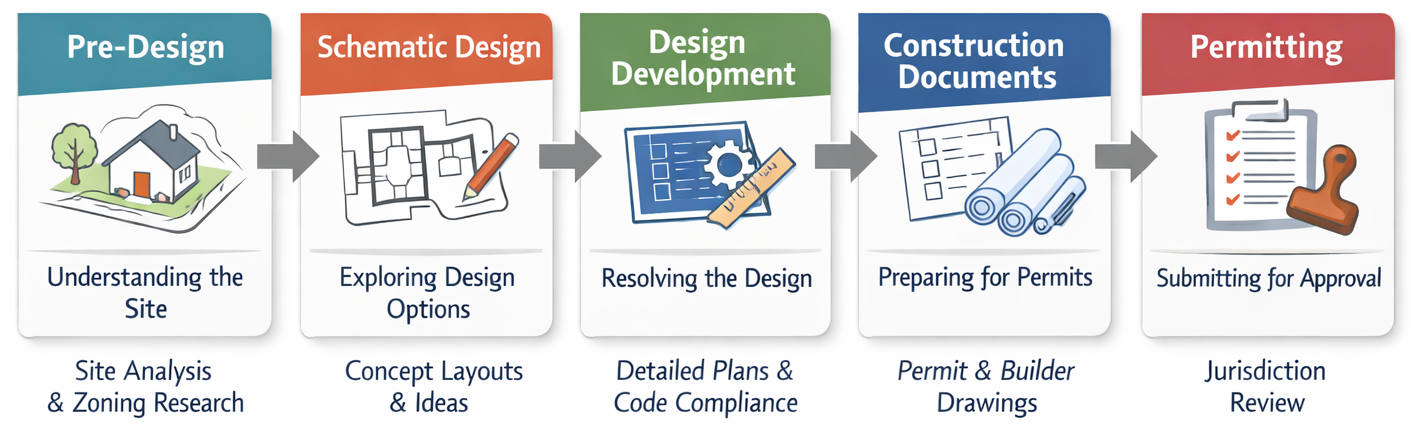
At Waldron Designs, projects move through a series of design phases before permits are submitted. Each phase builds on the previous one and helps transform a vision into a complete, buildable design.
The typical design process includes:
Pre-Design
Schematic Design
Design Development
Construction Documents
4. Pre-Design: Understanding the Site
Pre-design is where foundational research takes place.
This phase typically includes:
Site visits
Research into local zoning requirements
Evaluating topography and existing conditions
Understanding utilities and infrastructure
Analyzing views and sun orientation
Early conversations with the jurisdiction
This phase typically takes two to four weeks.
While it may not be the most visible stage of a project, it is one of the most important. Without it, it is easy to design something that cannot be approved.
5. Schematic Design: Exploring Possibilities
Once site constraints are understood, schematic design begins.
This phase focuses on exploration and collaboration.
Typical activities include:
Developing multiple layout options
Studying how the building responds to the site
Evaluating design directions
Refining the project vision
Schematic design typically takes four to six weeks.
6. Design Development: Resolving the Details
Design development is where the design becomes fully resolved.
During this phase, we determine:
How structural systems will function
How mechanical systems integrate into the design
How components connect and perform
How the project satisfies building codes
This stage is often the most rigorous portion of the design process and typically takes six to eight weeks.
7. Construction Documents: Preparing for Permits
Once the design is fully developed, the documentation required for permits and construction is created.
This phase includes two sets of drawings:
Permit Documents
Submitted to the jurisdiction
Demonstrate code compliance
Construction Documents
Provided to the builder
Include material specifications and detailed instructions
This phase typically takes six to eight weeks.
These drawings form the foundation of the permit application.
8. What Happens When Design Is Skipped
Sometimes homeowners try to shortcut the design process.
This often leads to problems such as:
Permit drawings that do not demonstrate code compliance
Multiple permit revisions or rejections
Confusion about jurisdiction requirements
Design issues discovered during construction
Increased project timelines and costs
In many cases, skipping design phases ultimately costs more time and more money.
9. What Smooth Permits Actually Look Like
Even when a project is carefully designed, permits are not always predictable.
Different jurisdictions interpret building codes differently. Requirements may change or new information may be requested.
A smooth permit process usually includes:
A fully developed design
Clear documentation demonstrating code compliance
Communication between the design team and the jurisdiction
A team ready to respond quickly to questions or revisions
Preparation and clarity often matter more than speed.
Starting the Right Way
If you are planning a renovation, addition, or new home, the first step is not creating drawings.
The first step is a conversation about:
Your goals and vision
Your site and property conditions
Local jurisdiction requirements
What is realistically possible for your project
This early work sets the foundation for everything that follows, including design development, permitting, and construction.

Waldron Designs, LLC is passionate about designing spaces rooted in their context and responsive to the natural environment. Are you ready to create sustainable permanence with your home?
GET IN TOUCH!